Overselling Across Channels: Causes, Risks, and How to Prevent It

There is a specific kind of "stomach-drop" moment that only e-commerce founders and operations managers truly understand. It’s Monday morning. You open your laptop to see a surge in sales from the weekend—a dream scenario, right? But then you look at your warehouse management system and realize the math doesn’t add up. You’ve sold 142 units of your flagship product, but you only had 110 in stock.
The "out of stock" notification didn't trigger in time on Amazon, and TikTok Shop kept taking orders while you were asleep. Now, you have 32 angry customers, a potential "account health" strike from the marketplace, and a team scrambling to send "we’re sorry" emails.
This is the reality of overselling across channels. In the age of omnichannel commerce, it is one of the most silent but deadly killers of brand reputation and scaling potential. Let’s dive into why this happens and, more importantly, how you can stop it before it sinks your store.
What Is Overselling Across Channels?
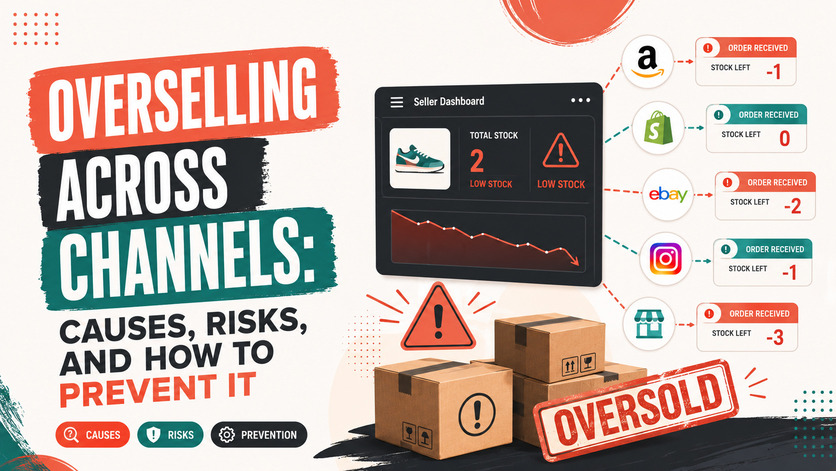
At its simplest, overselling across channels occurs when a business accepts an order for a product that is no longer available in its physical inventory because that stock was already sold through a different sales platform.
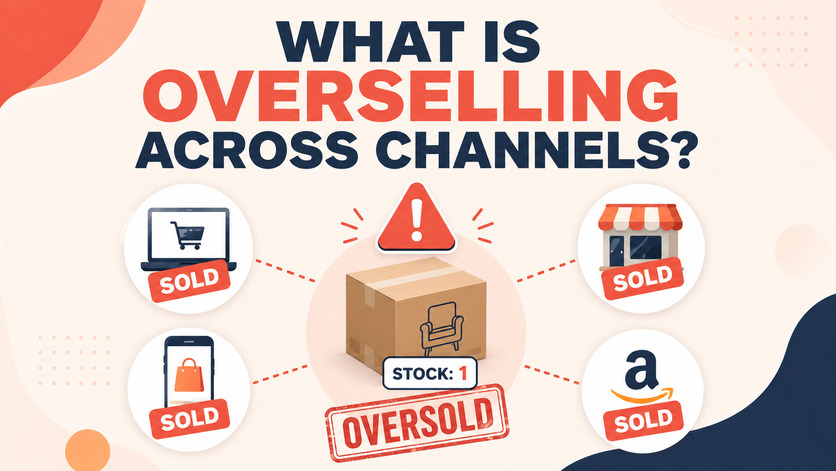
In a single-channel world (e.g., just selling on your own Shopify site), this is rare because your website usually knows exactly what’s in the back room. But in a multichannel world, you are likely selling on Shopify, Amazon, eBay, and perhaps social commerce platforms like Instagram or TikTok.
Overselling happens when these platforms don't "talk" to each other in real-time. If you have one candle left and a customer buys it on Amazon at 2:01 PM, but your Shopify store doesn't find out until 2:15 PM, a second customer could buy that same "ghost" candle at 2:05 PM. You are now in the red.
Why Overselling Happens in Multichannel Selling
You might wonder, "It’s 2025; why hasn't technology solved this yet?" The truth is that multichannel selling is exponentially more complex than linear selling.
The primary reason is data latency. Every platform has its own API (Application Programming Interface) and its own "heartbeat" for how often it checks for updates. Some platforms push data instantly; others pull data every 15 to 30 minutes.
Furthermore, the complexity of modern logistics—using multiple warehouses, 3PLs (Third-Party Logistics), or even "BOPIS" (Buy Online, Pick Up In-Store) models—creates multiple points of failure. If your warehouse team pulls a unit for a walk-in customer but doesn't scan it out of the digital system immediately, that unit is still "live" to the rest of the world.
Common Causes of Overselling Across Sales Channels
If you are struggling with inventory discrepancies, it usually boils down to one of these four culprits:
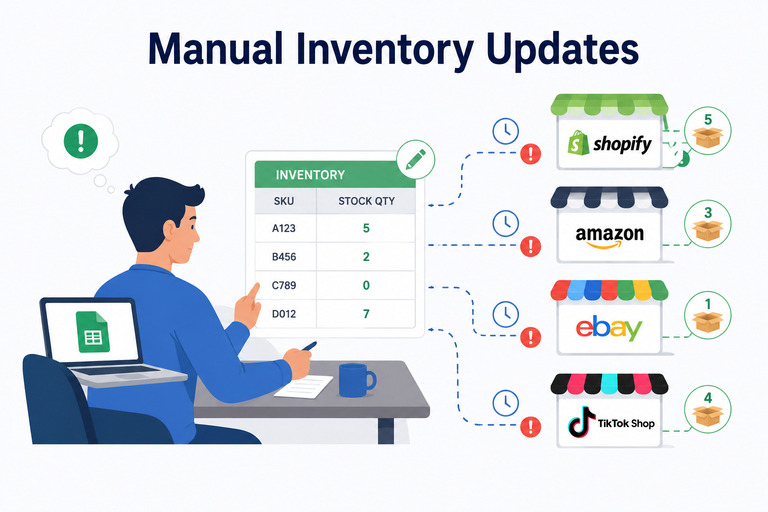
1. Manual Inventory Updates
Many growing brands start by using Excel spreadsheets to track stock. An employee spends their afternoon updating quantities across five different seller portals. This is a recipe for disaster. By the time you hit "Save" on the third platform, the first one is already out of date. Humans are slow; the internet is fast.
2. The "Viral" Spike
You send out an email blast or an influencer posts a Reel. Suddenly, you get 100 orders in three minutes. Most inventory sync tools have a "polling interval." If your tool only checks for new orders every 10 minutes, you can sell through your entire stock and go into a negative balance before the system even realizes a surge is happening.
3. Buffer Stock Mismanagement
Many sellers fail to account for "safety stock." They list 100% of their available inventory on every channel. If you have 5 units left and list 5 on Amazon and 5 on eBay, you are essentially gambling that two people won't buy them at the same time.
4. Returns and Damaged Goods
Sometimes, the inventory count is wrong because of "invisible" stock. A returned item might be checked back into the system automatically but is actually damaged and unsellable. Or, a "reserved" item for a pending order is accidentally counted as "available."
The Impact of Overselling on Ecommerce Businesses
Overselling isn't just an administrative headache; it’s a financial and reputational drain.
Marketplace Penalties
Platforms like Amazon and Walmart.com are obsessed with customer experience. If you cancel an order because you’re out of stock (Pre-fulfillment Cancellation Rate), they will penalize you. Cross a certain threshold (usually 2.5% on Amazon), and you risk account suspension. Losing your Amazon buy-box for a week can cost thousands in lost revenue.
The "Death Spiral" of Customer Service
One oversold item results in at least three extra touchpoints for your support team: the "apology" email, the "refund/alternative" negotiation, and the "follow-up" to ensure the customer isn't leaving a one-star review. This drains your team’s productivity.
Wasted Marketing Dollars
There is nothing more painful than spending $5.00 per click on Google Ads only for that customer to land on a "ghost" product. You’ve paid for the lead, but you can’t fulfill the promise.
Brand Erosion
In the age of social media, one disgruntled customer can reach thousands. A "They took my money and then told me it was out of stock" tweet is a bad look that no amount of fancy branding can fix.
How to Prevent Overselling Across Channels
The good news is that overselling is a solvable problem. It requires a shift from a "reactive" mindset to a "proactive" system.
1. Centralize Your Inventory (The Single Source of Truth)
Stop managing inventory inside individual seller portals. You need a centralized Inventory Management System (IMS). This software sits in the middle of your tech stack. When a sale happens on eBay, the IMS immediately deducts that unit from its master count and "pushes" the new, lower number to Shopify, Amazon, and Walmart.
2. Implement "Safety Stock" Buffers
Never list your last 2 or 3 items. A common strategy is to set a "buffer" of 5 units. When your stock hits 5, the IMS tells all sales channels that the item is "Out of Stock." This gives you a cushion for late-syncing orders or inventory errors. You can always sell those last 5 units manually or through your primary channel later.
3. Priority Channel Allocation
If you have limited stock, you can use "ringfencing." For example, if you have 20 units left, you might tell the system to give 15 to your Shopify store (where your margins are higher) and only 5 to Amazon.
4. Automate Your Warehouse Workflows
Use barcode scanning for everything. When an item is picked from the shelf, it should be scanned, and that "deduction" should happen in the cloud instantly. This eliminates the gap between physical reality and digital records.
Best Practices for Managing Inventory Across Multiple Channels
After working with hundreds of SKU-heavy brands, we’ve found that the most successful ones follow these "golden rules":
- Conduct Regular Cycle Counts: Don't wait for an end-of-year audit. Count a small section of your warehouse every week to ensure your digital numbers match your physical bins.
- Sync Frequently: Check your software settings. If your sync interval is set to 30 minutes, try to get it down to 5 minutes or less.
- Kits and Bundles Awareness: If you sell a "Skin Care Kit" that includes a cleanser and a moisturizer, ensure your system knows that selling one "Kit" means deducting one of each individual item from the stock.
- Monitor "Pending" Orders: Amazon often holds orders in "Pending" for hours while verifying credit cards. Ensure your inventory system accounts for these "soft-allocated" units so they aren't sold elsewhere while they are in limbo.
Tools That Help Reduce Overselling Risks
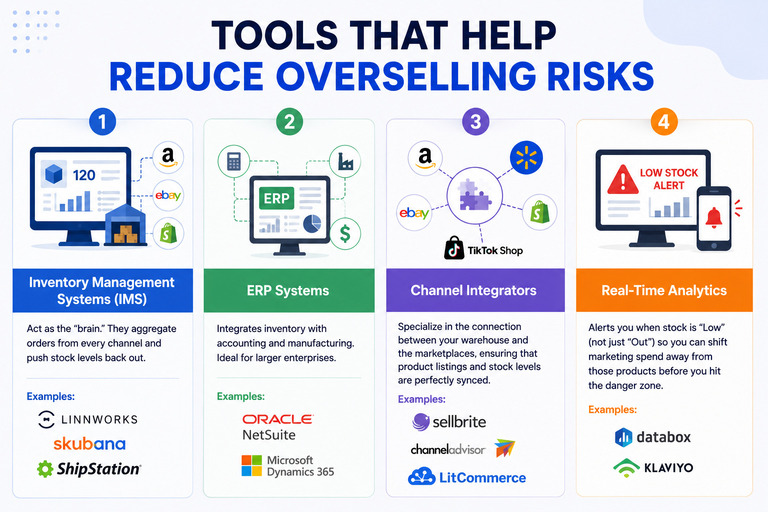
You cannot solve this problem with a bigger spreadsheet. You need a robust tech stack. Here are the categories of tools that actually move the needle:
1. Inventory Management Systems (IMS)
Tools like Linnworks, Skubana (Extensiv), or ShipStation (Inventory) act as the "brain." They aggregate orders from every channel and push stock levels back out.
2. ERP Systems
For larger enterprises, an ERP (Enterprise Resource Planning) like NetSuite or Microsoft Dynamics integrates inventory with accounting and manufacturing, though these are often "heavier" and more expensive to implement.
3. Channel Integrators
Tools like LitCommerce, Sellbrite or ChannelAdvisor specialize in the connection between your warehouse and the marketplaces, ensuring that product listings and stock levels are perfectly synced.
4. Real-Time Analytics
Using a tool that alerts you when stock is "Low" (not just "Out") allows you to shift marketing spend away from those products before you hit the danger zone.
Frequently Asked Questions About Overselling Across Channels
Q: Is it possible to prevent overselling 100%?
A: To be honest, no system is perfect. A massive, simultaneous spike in sales (like a Super Bowl ad) can occasionally beat the sync speed of any API. However, with the right tools, you can reduce the risk from "common occurrence" to "once in a blue moon."
Q: How much safety stock should I keep?
A: This depends on your sales velocity. For high-volume items, a buffer of 5–10% is healthy. For slow-moving, high-ticket items, a buffer of 1 unit might be enough.
Q: What should I do if I’ve already oversold?
A: Be honest and be fast. Email the customer immediately. Offer an alternative, a discount on a future order, or a clear timeline for when the item will be back in stock. If it’s on a marketplace like Amazon, try to ship the item from a different source (even if you have to buy it at retail from a competitor) to avoid the cancellation penalty.
Q: Does FBA (Fulfillment by Amazon) help prevent overselling?
A: Yes, because Amazon manages that stock. However, it creates a new challenge: "Multi-Channel Fulfillment" (MCF). If you use your FBA stock to fulfill Shopify orders, you still need an IMS to make sure your Shopify store knows how much stock is left in the Amazon warehouse.
Conclusion
Overselling across channels is a "growing pain." It usually happens when a business is doing well—selling in more places and reaching more people. But if left unchecked, it can destroy the very growth that caused it.
By moving away from manual updates, implementing a "Single Source of Truth" with an IMS, and respecting the power of safety stock, you can stop worrying about "ghost inventory" and start focusing on scaling your brand. Remember: in e-commerce, consistency is just as important as conversion. Don't just make the sale—ensure you can deliver it.


.jpg)